 Maryland Personal Injury Lawyers






If you have a Maryland workers’ compensation claim, you likely have a lot of questions about the comp settlement chart, how long it will take to get a settlement check, whether you can be fired, how much workers’ comp pays, and what happens if the insurance company starts pushing back. Our lawyers try to answer your anticipated questions.
Workers’ compensation is supposed to be simple. You get hurt at work, you report the injury, you get medical treatment, and you receive wage benefits if you cannot work. In real life, it is often not simple. The insurance company may deny the claim, send you to one of its doctors, argue your injury is preexisting, cut off your checks, or push you back to light duty before you are ready.
This page gives answers to the most common Maryland workers’ compensation questions our lawyers hear from injured workers. Some answers are straightforward. Others depend on your medical records, your wage history, your work restrictions, your impairment rating, and whether someone outside your employer also caused the injury.
If you were injured on the job in Maryland, call Miller & Zois today at 800-553-8082 or get a free online consultation. You do not have to wait until the insurance company denies your claim to get legal advice.
Maryland Workers’ Comp Quick Reference Chart
Workers’ comp numbers change every year. The date of injury matters because the applicable compensation rates are tied to the year of the accident. For injuries occurring on or after January 1, 2026, the Maryland Workers’ Compensation Commission lists the State Average Weekly Wage as $1,537.00.
| Issue | 2026 Maryland Rule or Number | What It Means |
|---|---|---|
| Temporary Total Disability | Two thirds of average weekly wage, capped at $1,537.00 | This is the wage benefit if you cannot work because of the work injury. |
| Temporary Partial Disability | 50% of the wage difference, capped at $769.00 | This may apply if you return to work but earn less because of injury restrictions. |
| Permanent Partial Disability, Less Than 75 Weeks | One third of average weekly wage, capped at $257.00 | This applies to smaller permanent partial disability awards. |
| Permanent Partial Disability, 75 to 249 Weeks | Two thirds of average weekly wage, capped at $513.00 | This applies to mid-level permanent partial disability awards. |
| Serious Disability Benefits | Two thirds of average weekly wage, capped at $1,153.00 | This applies to qualifying awards of 250 weeks or more. |
| Mileage Reimbursement | 72.5 cents per mile | This applies to compensable medical travel when mileage reimbursement is owed. |
This chart is not a settlement calculator. Your settlement value depends on your wage, injury, treatment, disability periods, impairment rating, whether you can return to work, whether future medical benefits remain open, and whether you also have a third-party claim.
Can You Get Fired While on Workers’ Comp in Maryland?
Our lawyers get this question frequently. Comp victims fear being fired for bringing a workers’ comp claim or remaining out of work. That fear is not irrational. Injured workers often feel like the employer is friendly at first and then suddenly cold when the claim gets expensive or the worker cannot return quickly.
Maryland Labor & Employment Code Ann. § 9-1105(a) prohibits an employer from discharging a covered employee solely because the employee filed a workers’ compensation claim. It is not an ambiguous statute. Your employer cannot fire you solely because you brought a comp claim. Period.
But you need to understand the word “solely.” Maryland workers’ comp law does not give injured employees lifetime job security. An employer may still argue it fired someone for a legitimate reason unrelated to the claim, such as layoffs, misconduct, job abandonment, or inability to perform the job after all leave rights are exhausted. The fight is often over the real reason for the firing.
If an employee is fired for bringing a workers’ comp claim, Maryland recognizes a cause of action for wrongful termination. Two Maryland cases underscore the right to bring a lawsuit if you are fired for bringing a comp claim: Ewing v. Koppers Co., 312 Md. 45 (1988), and Kern v. South Baltimore General Hospital, 66 Md. App. 441 (1986).
If you were fired after filing a comp claim, save every email, text, write-up, attendance notice, light-duty note, and work restriction. The employer will tell its side. You need the documents that tell yours.

How Long Does It Take to Get a Workers’ Comp Settlement Check in Maryland?
After a settlement is reached, it still must be approved by the Maryland Workers’ Compensation Commission. That approval step matters. The insurance company does not send the final settlement check just because you and the insurer agreed on a number. The settlement papers have to be prepared, signed, submitted, reviewed, and approved.
Once there is an award or approved payment due, Maryland law generally requires the employer or insurer to begin paying compensation within 15 days after the later of the date the award is made or the payment is due. Does it sometimes take a little longer to get a workers’ comp check? It does. If it is more than a few days late, you have a legitimate complaint.
There are also penalties when an employer or insurer fails, without good cause, to begin paying an award on time. If the payment is not started within 15 days, the Commission may assess a fine of up to 20% of the payment. If the payment is not started within 30 days, the fine may be up to 40%. The Commission orders those fines paid to the covered employee.
How Long Do You Have to Report an Injury to Workers’ Comp in Maryland?
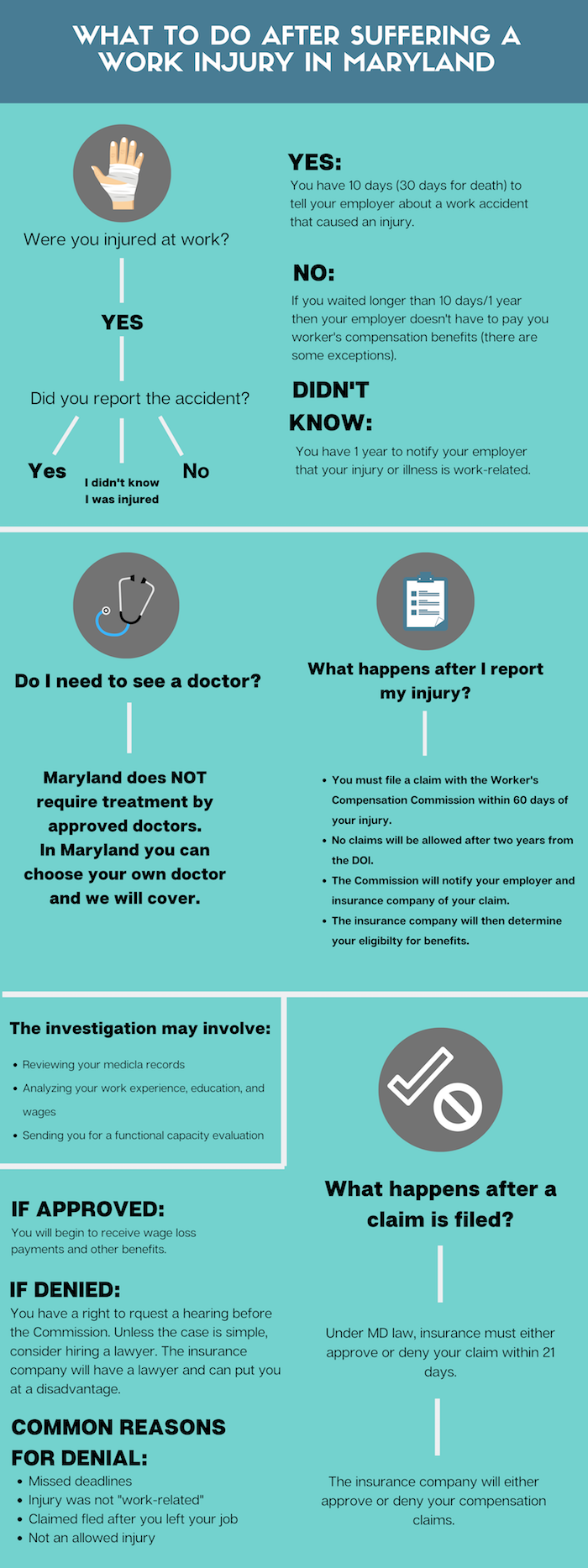
Under Maryland law, a covered employee must give oral or written notice to the employer within 10 days after an accidental personal injury. If the employee dies from the work injury, notice generally must be given within 30 days after death.
But failure to provide notice may be excused if there was a sufficient reason for the failure to comply or if the employer or its insurer was not prejudiced by the failure to comply. That exception helps some injured workers. But it is not a fight you want to be having.
The safest rule is simple: report the injury immediately, preferably in writing. Tell your supervisor, manager, foreman, human resources person, or whoever your employer designates for injury reporting. A text, email, incident report, or written note is better than a conversation that someone later denies.
Are Volunteers Covered Under Workers’ Compensation Law in Maryland?
The Maryland Workers’ Compensation Act generally applies to paid employees. Volunteers are not eligible to receive comp benefits under workers’ comp unless the statute specifically allows for it.
The Maryland Legislature has created exceptions in the statute, most notably for certain volunteer police officers, volunteer firefighters and rescue workers, and certain students. These categories can be complicated because coverage may depend on the type of volunteer work, the county, the public entity involved, whether the volunteer was on duty, and the specific statutory section.
If you were hurt while volunteering, do not assume you are out. But do not assume you are covered either. Volunteer coverage is statute-specific. A lawyer needs to look at the exact role you were performing when you were injured.
How Much Does Workers’ Comp Pay in Maryland?
Generally, temporary total disability benefits are two thirds of your average weekly wage, subject to the statutory maximum. Of course, there are potentially other benefits as well, including medical treatment, temporary partial disability, permanent partial disability, permanent total disability, mileage reimbursement, vocational rehabilitation, and death benefits.
For 2026 injuries, the maximum temporary total disability benefit is $1,537.00 per week. That does not mean everyone gets that amount. If two-thirds of your average weekly wage is less than the maximum, you get the lower number.
The mistake injured workers make is focusing only on the weekly check. The value of the claim is bigger than the weekly benefit. Medical treatment, future surgery risk, permanent impairment, work restrictions, inability to return to the old job, and a possible third-party case can matter even more.
What Is the Maximum Average Weekly Wage Under the Maryland Workers’ Compensation Statute?
The old answer on this page used the 2021 rate. That is outdated. For injuries occurring on or after January 1, 2026, the Maryland Workers’ Compensation Commission lists the State Average Weekly Wage as $1,537.00.
For temporary total disability, the 2026 maximum is two-thirds of the employee’s average weekly wage, not to exceed 100% of the State Average Weekly Wage, or $1,537.00. Permanent total disability uses the same 2026 maximum.
Different categories of permanent partial disability have different caps. That is why settlement value is not just “two thirds of your wages.” The body part, impairment rating, number of weeks, tier, and whether the case qualifies as serious disability can all change the number.
Are Taxes Taken Out or Payroll Deductions for Workers’ Compensation Payments in Maryland?
Taxes and payroll deductions are generally not taken out of your workers’ comp payments in Maryland. This is one reason the benefit is usually two thirds of your average weekly wage. The check is smaller than your regular paycheck, but it is generally not reduced by the same taxes and payroll deductions.
Under IRS guidance, amounts you receive as workers’ compensation for an occupational sickness or injury are generally exempt from federal income tax if they are paid under a workers’ compensation law. There are exceptions, especially if part of your workers’ compensation reduces Social Security or equivalent railroad retirement benefits.
Our lawyers are not tax advisers. If you have a large settlement, Social Security Disability, retirement benefits, or unusual tax concerns, you should speak with a qualified tax professional.
What Is Workers’ Compensation?
Workers’ compensation in Maryland comes from a state statute that allows for benefits if you are either injured on the job or develop an illness that can be related to your job. This entitles you to money for your medical treatment and some or all of your lost earnings. Our system is a no-fault system. So if your mistake caused your injuries, you can still recover the same as any other injured worker.
All of that is good. The problem with these claims, however, is that you never get fair compensation for your injuries in the way you might in a personal injury lawsuit. You may get wage benefits and medical expenses. But you are not getting pain and suffering damages against your employer. You are not getting the full measure of what a jury might award in a civil case.
That is the workers’ compensation bargain. You do not have to prove your employer was negligent. But you usually give up the right to sue your employer for full tort damages. This is why our lawyers always ask whether a third party, such as a negligent driver, subcontractor, property owner, manufacturer, or another company, played a role in causing the injury.
Who Is Covered?
The law is pretty generous in defining covered employees. If you are on your company’s regular payroll, you should be covered. Temporary employees may also be covered. Undocumented workers may also have rights under Maryland workers’ compensation law.
The fights usually come when the employer or insurer claims you were not really an employee. They may say you were an independent contractor, casual employee, partner, sole proprietor, volunteer, or someone outside the statutory definition of a covered employee.
The label your employer gives you is not always controlling. Employers sometimes call workers “independent contractors” because it is convenient, not because the law agrees. If you were hurt while working and your employer says you are not covered, you should have a lawyer review the work relationship before giving up.
What Is the Statute of Limitations to Seek Benefits?
Many people get burned assuming that the statute of limitations is three years, just like a regular tort lawsuit. It is not that simple. Workers’ compensation deadlines are shorter, stranger, and more unforgiving.
| Deadline | General Maryland Rule | Why It Makes a Difference |
|---|---|---|
| Notice to employer for accidental injury | 10 days | There are ways around missed notice in some cases, but it is not a fight you want to have. |
| Claim filing for accidental injury | 60 days | The Commission can excuse some late filings, but there is a hard two-year bar in most accidental injury cases. |
| Death claim from accidental injury | 18 months after death | Death claims have their own deadline and should be filed quickly. |
| Occupational disease claim | Generally two years to file after disablement or knowledge of the work connection | Occupational disease cases can be harder because the injury develops over time. |
| Appeal from Commission order | Generally 30 days after mailing of the order | If you get an order you do not understand, call a lawyer immediately. |
To summarize, there are many deadlines. The laws change. The rules change. There are exceptions we have not fully explored here. Make sure you are talking to a lawyer about these deadlines so you know you have fully complied with these obligations.
When we start talking about the statute of limitations, justice goes out the window. These deadlines can be very harsh.
How Is the Average Weekly Wage Calculated to Determine Compensation?
The average weekly wage is one of the most important numbers in a Maryland workers’ compensation claim. It drives your temporary disability checks and can influence settlement value.
The average weekly wage is typically based on your earnings before the injury. In many claims, the wage statement looks at the period before the accident and averages the wages during that period. Overtime, bonuses, tips, and irregular earnings can create disputes. If you were new to the job, worked part time, missed time, worked seasonal hours, or had variable overtime, the calculation may be more complicated.
Do not assume the insurer calculated your average weekly wage correctly. Insurance companies can make mistakes, and those mistakes usually benefit them, not you.
What Percentage of My Average Weekly Wage Will I Get?
In temporary total disability cases, the employee generally gets two-thirds of the average weekly wage, not to exceed 100% of the State Average Weekly Wage. For 2026 injuries, that cap is $1,537.00.
Other categories of injury have different rates. Temporary partial disability is different. Permanent partial disability is different. Serious disability benefits are different. That is why a quick answer like “two thirds of your wages” is useful, but incomplete.
You can find the current rates on the Maryland Workers’ Compensation Commission rate page.
Can I Get Additional Money If I Have Suffered a Disfigurement?
Yes. You can get additional compensation if you have a disfigurement or other permanent injury. But the compensation is often very low compared to what the same injury might be worth in a personal injury lawsuit. The maximum award for disfigurement or mutilation is 156 weeks.
This is another example of the limits of workers’ comp. The system pays benefits. It does not usually compensate you the way a jury verdict might compensate you for the human impact of a visible scar, deformity, or permanent change in appearance.
Can I See the Doctor I Want or Do I Have to Go to the Insurance Company’s Doctor?
Maryland is, thankfully, a free choice state. Generally speaking, you can see the doctor of your choice for your injuries. That matters because your treating doctor can make or break your case on disability, causation, restrictions, surgery, and permanent impairment.
But you may have to be evaluated by the insurance company’s doctor at some point so the insurer can better evaluate your claim. This is often called an independent medical evaluation, but there is nothing truly independent about it from the injured worker’s perspective. The doctor was selected by the insurance company.
If the insurer’s doctor says you can return to work, need no more treatment, or have little permanent impairment, the insurance company may use that report to cut off benefits or reduce settlement value. Talk to a lawyer before assuming that report is the final word.
Can I Receive Workers’ Compensation for a Preexisting Condition?
Yes. A preexisting condition does not automatically defeat a Maryland workers’ compensation claim. If a workplace accident aggravates, accelerates, or worsens an old injury or underlying medical condition, you may still be eligible for benefits.
This comes up all the time with back, neck, shoulder, knee, and arthritis claims. The insurance company may argue that your MRI already showed degeneration, that you had prior pain, or that your condition was going to get worse anyway. But that is not the end of the case. The real question is whether the work accident changed something. Did you have new symptoms? Did your pain become worse or more frequent? Did you need treatment you did not need before? Did you miss work for the first time? Did the accident turn a manageable condition into a disabling one?
These cases depend heavily on the medical evidence. Strong proof may include records showing you were working without restrictions before the accident, a clear change in symptoms after the accident, new imaging findings, new treatment recommendations, surgery, disability slips, or a doctor’s opinion connecting the worsening condition to the work injury.
So do not assume you have no claim just because you had a prior injury or some degeneration on an MRI. Many workers have preexisting conditions. What matters is whether the work accident made that condition worse and caused new medical treatment, new disability, or a permanent worsening of your condition.
Should I Settle My Maryland Workers’ Compensation Claim?
Maybe. But you need to understand exactly what you are giving up before you sign anything. A full and final settlement in Maryland can close your case permanently. Once approved, you generally cannot come back later and ask for more money because your condition got worse, you needed surgery, or you lost the job you thought you could keep.
Settlement can make sense once your medical picture is clear, your disability value has been developed, and the settlement amount actually accounts for future risks. It can be a mistake if you settle before surgery, before maximum medical improvement, before an impairment rating, or before you understand whether future medical benefits are being closed.
The insurance company often wants to settle while there is still uncertainty about your future because uncertainty can work in its favor. Before you agree to a number, you should know what your claim is worth, what treatment you may still need, and what rights you are permanently giving up.
Can I Have a Workers’ Compensation Claim and a Personal Injury Claim?
Yes. This is one of the most important points in Maryland work injury cases. Workers’ compensation is usually your remedy against your employer. But if someone other than your employer caused your injury, you may also have a third-party personal injury claim.
Examples include a delivery driver hit by another vehicle, a construction worker injured by a subcontractor, a worker hurt by defective equipment, or an employee injured because of a dangerous condition on property controlled by someone else.
Why does this matter so much? Because workers’ compensation does not usually pay pain and suffering. A third-party lawsuit can. In serious injury cases, the third-party claim may be where the real money is.
What to Do if You Need a Baltimore Attorney for Your Claim
If you have suffered an injury on the job or have lost a loved one from an on-the-job injury, call us today at 800-553-8082. You can also get a free no-obligation consultation.
You do not need to know the value of your case before calling. You do not need to know whether your employer is right about light duty. You do not need to know whether the insurer calculated your wage correctly. Those are the questions we help answer.