 Car Accidents






Our law firm handles herniated disc accident cases in Maryland and around the country. Our lawyers have handled hundreds of herniated disc cases and have received national attention for our verdicts. Our attorneys know the science and the medicine of these cases very well.
Below are commonly asked questions about herniated disc injuries caused by car accidents and other trauma. We provide examples of settlements and jury verdicts where the primary injury was a herniated disc as well as sample MRI reports and operative notes. Follow the links below if you have a specific area of interest.
Commonly Asked Questions
- What is a herniated disc and how do car accidents cause spinal injuries?
- What is the most common type of herniated disc injury from car accidents?
- How are herniated discs treated?
- How does having a pre-existing spinal injury affect my herniated disc claim?
- What does an MRI reveal and not reveal about disc injuries?
- What is the value of these cases in Maryland jurisdictions?
- How Much Compensation Will I Get For A Herniated Disc Case?
- What Impacts The Value Of Herniated Disc Cases?
- Is A Herniated Disc Injury Hard To Prove In A Lawsuit?
- Maryland herniated disc verdicts and settlements
- Additional information and resources (MRI reports, etc.)
- Hire a lawyer to fight for you
What is a Herniated Disc and How Do Car Accidents Cause Spinal Injuries?
Spinal discs are circles of tissue in between the vertebrae of the spinal column. These discs hold the vertebrae together, assist in motion, and act as shock absorbers between the vertebrae. Structurally, the discs are made up of a tough outer shell that surrounds a liquid center. A metaphor we often use with juries in personal injury cases is that the discs are like jelly donuts. If a disc is injured as the result of trauma in an auto accident, the center may leak out of the disc. This rupture is known as a herniated disc. These are serious injuries that can result in chronic pain or weakness.
If the inner core of the disc extrudes into the spinal canal, it may put pressure on nerve roots, causing pain to radiate throughout the person’s body. The pain is not felt in the back, but rather in the areas of the body whose nerves are connected to the area of the spine where the disc herniation is located. Typically, this radicular pain is described as a shooting pain that goes to one area of the body. Where the pain radiates in the body depe
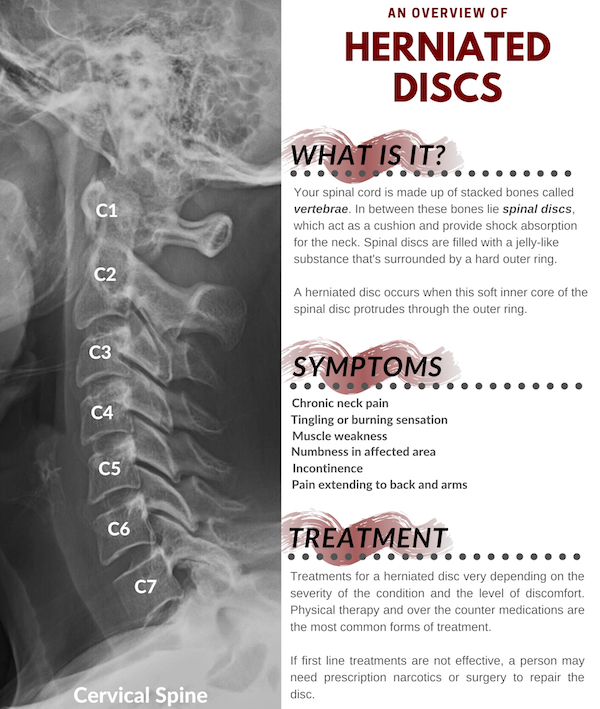
nds on where the disc herniation occurs. It occurs in the leg if the herniation is in the lumbar spine, or lower back, or in the arm if the herniation is in the cervical spine, or neck.
Herniated disc injuries are rarely diagnosed in the emergency room after a motor vehicle accident. This is because the spinal discs are invisible on an x-ray. Accordingly, a patient typically needs a CT scan or magnetic resonance imaging (MRI) test in order to be properly diagnosed. Discography, myelography, and electromyography are also used to diagnose compromised discs.
However, medical experts agree that these diagnostic tests cannot diagnose the amount of pain that the victim is experiencing. Due to the complexity of the spinal column and nervous system, there is no clear-cut correlation between the degree of the herniation and the patient’s pain symptoms.
What is the Most Common Type of Herniated Disc Injury from Car Accidents?
The neck, or cervical spine, is the most common location to find a herniated disc as a result of a car accident. In a car accident, most of the body is restrained by the seatbelt. The neck, however, is not restrained, and can whip forward, backward, or sideways, resulting in injury. Specifically, the most commonly injured vertebrae are the C4-C5 and C5-C6 pairs.
Patients who have a C4-C5 injury primarily complain of weakness or pain in the shoulders or deltoids. The C4 and C5 nerves provide motor function to the muscles of the arm and shoulder. A herniated disc in this area often results in nerve root impingement, and when these nerves are compromised, the result is often muscle weakness.
This weakness in the arm and shoulders does not usually cause numbness and tingling. However, some patients do experience these sensations. If the client complains of numbness and tingling with a C4-C5 injury, the doctor evaluating the claim for the insurance company will cite this as evidence that the client is not being forthright and is possibly exaggerating her injuries.
“The cervical spine, or the neck, is the most common place to find a herniated disc after a car accident.”
C4-C5 cases have greater value when the victim has a physically demanding job since the injury will affect their ability to work. Good lawyers should be able to position cases well for any victim who has muscle weakness.
In contrast, a C5-C6 injury often causes numbness, tingling, and radiating pain down to or near the patient’s thumb. Other symptoms include generalized pain, stiffness, and a restricted range of motion. A C5-C6 injury may also cause weakness in the biceps and the wrist extensor muscles.
With C5-C6 disc injuries, insurance companies will try to minimize the severity of the plaintiff’s injury by citing range of motion and foraminal closure, or Spurling, tests. These tests attempt, with various bodily movements, to intentionally provoke the patient’s symptoms. A physician may try applying pressure on the top of the head, turning the neck to one side or the other, rotating the neck and pushing down, or applying pressure targeting the bones.
How are Herniated Discs Treated?
The course of treatment for a herniated disc typically begins with a combination of medication to limit inflammation and physical therapy. Sometimes steroid injections are administered to help with swelling and healing. If this initial line of treatment is not successful, there are a variety of surgical options available to treat disc herniation. As a patient receives more expensive and invasive treatment, the value of their case will likely increase.
How Does Having a Pre-Existing Spinal Injury Affect my Herniated Disc Claim?
Pre-existing injuries make these cases more complicated. Pointing a finger at pre-existing degenerative problems with a patient’s spine is a favorite tactic of lawyers defending personal injury cases on behalf of insurance companies. Pre-existing spinal conditions include problems such as spinal stenosis, osteoarthritis, and spondylolisthesis. These conditions begin to manifest in many people in their early 30s. Therefore, it must be established that the patient’s injuries and pain are not due to the degenerative condition, but to the trauma sustained in the accident.
“Having a pre-existing condition makes it harder, but not impossible, to win a fair personal injury settlement.”
Sometimes, plaintiffs have a pre-existing herniated disc or degenerative changes. But, before the accident, their condition was asymptotic, that is, it did not cause any pain, weakness, or other symptoms. In Maryland, there are two jury instructions that apply to this situation, the susceptibility instruction (Maryland Pattern Jury Instruction 10:3) and aggravation of preexisting condition instruction (Maryland Pattern Jury Instruction 10:4). The former says that the fact that an injury would have been less severe if it happened to someone else should not affect the amount of damages a victim is awarded. The latter says that a person with a pre-existing condition is allowed to be awarded damages for the aggravation of that condition. In other words, your condition would have been less severe, and may not have even caused you any pain, if not for the accident.
Most importantly, you must be able to clearly articulate the difference between your condition before the auto accident and your current condition. If there is no difference in your condition after the accident, your chances of getting a substantial recovery diminish dramatically. On the other hand, if there is a notable difference in your pain, way of life, and treatment after the motor vehicle collision that would not have occurred in the absence of the accident, the odds of a quality settlement increase dramatically.
- Learn more about how to maximize the value of claims where the insurance company is arguing degenerative disc disease
What Does an MRI Reveal and not Reveal About Disc Injuries?
The results of your MRI will be crucial to the settlement value or trial value of your case. Insurance adjusters and defense lawyers will likely spend more time debating the significance of your MRI than any other part of your case. The problem is that two patients with identical MRIs can have completely different symptoms. One may experience little to no pain at all while the other is suffering severe, debilitating pain.
An MRI, which stands for magnetic resonance imaging, is a type of medical imaging that utilizes digital magnetic fields to produce a detailed computer image of the inside of the body. Whereas a traditional x-ray can only show outlines of bone structures, an MRI uses magnets and radio waves to produce a multi-dimensional cross-section of soft tissue. The ability to see soft tissue is critically important to diagnosing a herniated disc.
If you start to experience pain or discomfort after being in a car accident, getting an MRI is a good idea. The first step is to see your primary care doctor or go to an urgent care clinic. If the doctor believes that an MRI might be necessary to diagnose your condition, he or she will write a lab order and refer you to an MRI imaging lab to have the scan done. MRIs are expensive, but the cost should be fully covered if you have health insurance.
“An MRI is critical in the diagnosis of a herniated disc.”
If you are young with no prior history of back issues and you start experiencing symptoms right after a car accident, your doctor will have little difficulty concluding that the accident caused your injuries. In cases where this conclusion is less obvious, the results of an MRI scan can sometimes provide definitive evidence that your disc herniation was the result of acute trauma, consistent with a car accident, as opposed to chronic deterioration over time.
If you are looking at your own MRI and see the terms “degenerative,” “arthritis,” or “spondylosis,” the films are showing that your spinal injury occurred over time. Importantly, that does not mean that the symptoms of your injury are not related to the crash. Often, a patient has an asymptomatic herniated disc that becomes symptomatic due to the trauma of the car accident. If you can prove that this is the case by showing the difference in your symptoms before and after the accident, it does not matter if the MRI shows a pre-existing injury.
If someone has experienced multiple traumatic events, it can be a challenge to determine which accident in particular caused the herniated disc injury. Experts cannot determine within a reasonable degree of medical certainty how or when a disc herniation originated solely on the basis of an MRI scan finding. The only way to determine when a disc herniation occurred is by listening to the patient and reading their medical records.
What is the value of These Cases in Maryland Jurisdictions?
Our lawyers have handled hundreds of herniated disc injury cases in Maryland, and we have a good idea of the value of these cases. The average jury verdict in disc cases nationally over the last three years is around $360,000. This average is driven up by a small number of large cases, and the median, middle of the road jury verdict is closer to $80,000.
This video breaks down how herniated disc cases are valued in Maryland by looking not only at the injury, but the specific jurisdictions in Maryland and how that impacts settlement value.
How Much Compensation Will I Get For A Herniated Disc Case?
The median value of a herniated disc injury case in Maryland is around $70,000 to $100,000, depending on the severity. However, the most serious herniated disc injuries can have a typical value in the $250,000 to $350,000 range.
What Impacts The Value Of Herniated Disc Cases?
One of the primary factors that drives the settlement value of herniated disc cases is the severity of the disc injury and level of treatment it requires. There are 3 basic levels of treatment for herniated discs: (1) physical therapy + pain medication; (2) epidural steroid injections; and (3) back surgery. The high the level of treatment the more the injury is worth. Another factor which significantly impacts case value is the age of the plaintiff and whether they had pre-existing back issues. Younger plaintiffs with no history of degenerative back problems tend to get higher settlements.
Is A Herniated Disc Injury Hard To Prove In A Lawsuit?
No. A herniated disc is something that can be accurately diagnosed through either a physical examination or by an MRI. In most cases, whether the plaintiff has a herniated disc is not disputed. The focus is usually on whether the disc herniation was caused by the accident or pre-existing, degenerative conditions.
Herniated Disc Verdicts & Settlements
Below is a list of herniated disc verdicts and settlements. We provide these examples so that victims and lawyers can compare their cases in order to figure out a range of values. Keep in mind that it is hard for anyone to ascertain the value of an individual case without reading and understanding all of the nuances contained in medical records and learning all of the details of the case.
- 2024, Maryland: $31,684 Verdict. The plaintiff, a 64-year-old male, said his vehicle was rear-ended by the defendant while he was stopped in traffic, the force of which propelled his vehicle forward and into the rear of the vehicle stopped ahead of him. The plaintiff reported injuries including a concussion with memory lapses and disc herniation at L4-L5 with spinal nerve encroachment, disc protrusion at L5-S1 with spinal radiculopathy and a cracked tooth. The plaintiff claimed his injuries are permanent and noted that he underwent lumbar surgery.
- 2023, Maryland: $219,400 Verdict. The plaintiff was driving through an intersection when the defendant suddenly changed lanes crossed into her lane and caused a collision. The plaintiff reported injuries including disc tears and herniations to her lumbar spine at L5-Sl, which required injection therapy, as well as concussion and soft tissue cervical and thoracic strains. The verdict included $25,528 in past medical expenses and $151,500 in future medical expenses.
- 2021, Maryland: $2,051,652 Verdict. The plaintiff was stopped for traffic when she was rear-ended by an underinsured driver. The plaintiff allegedly suffered a herniated disc in her low back which required surgery. The plaintiff received the policy limits of $30,000 from the insurer for the underinsured motorist and sought additional benefits under her automobile policy with defendant State Farm , under which she was entitled to $100,000 in UIM benefits. The plaintiff alleged the defendant breached the insurance policy, asserting the defendant failed to timely and properly negotiate a reasonable settlement for her damages. A jury trial was held on the extent of damages only.
- 2020, Maryland: $562,797 Verdict. A man was sideswiped. He suffered a C3-4 herniation, an L5-S1 bulge, lumbar radiculopathy, nerve root compression, left foot numbness, an irritated left eye, a head laceration, facial abrasions and burns, and a traumatic brain injury. The man was left with post-traumatic headaches, post-traumatic stress disorder, and post-concussion syndrome. He alleged that the at-fault driver’s failure to yield the right-of-way and pay attention to the road caused his injuries. The Prince George’s County jury awarded $562,797.
- 2019, Maryland: $236,254 Verdict. A man stopped near a crosswalk. He was rear-ended. The man suffered a cervical herniation. He underwent neck surgery. The man alleged that the at-fault driver’s failure to slow down and avoid a collision caused his injuries. He received a $236,254 verdict in Anne Arundel County.
- 2019, Maryland: $200,000 Verdict. A woman lawfully entered an intersection. She was struck by a pickup truck. The woman suffered multiple cervical and lumbar injuries, including a C5-6 herniation. The woman also developed radiculopathy. She alleged that the at-fault driver’s negligent driving caused her injuries. The woman claimed he made an unsafe right turn and failed to yield the right-of-way. An Anne Arundel County jury awarded $200,000.
- 2019, Maryland: $7,483,254 Verdict. A 40-something man was rear-ended at a gas station. He suffered a lumbosacral herniation. The man also suffered the aggravation of his pre-existing degenerative cervical disc disease and radiculopathy. He initially underwent physical therapy. Two years later, the man underwent a discectomy and two-level fusion. His injuries failed to resolve. The man underwent a lumbar revision two years later. He continued to experience residual impairments. The man alleged negligence against the at-fault driver. He claimed he failed to maintain an appropriate lookout and avoid the collision. The man received a $7,483,254 verdict.
- 2019, Maryland: $56,600 Verdict. A 60-something man was rear-ended at the intersection of Route 29 and Route 40. He suffered cervical and lumbar bulges and herniations, neck impingement, and right shoulder tear and tendinitis. The man underwent physical therapy and steroid injections. He sustained residual spinal pain, right arm paresthesia, and right shoulder weakness. The man alleged that the at-fault driver’s failure to avoid the collision and timely brake caused his injuries. A Howard County jury awarded $56,600.
- 2018, Maryland: $200,000 Settlement Our client, a seat-belted driver, was driving on a clear and dry day on Maryland Route 695 in Baltimore County when he came upon traffic ahead of him and slowed his vehicle accordingly. The defendant rear-ended him. He underwent C5-C6 anterior cervical discectomy and fusion surgery for decompression and stabilization of his spinal cord nerve roots. The insurance companies argued that the injuries were pre-existing and degenerative but ultimately paid the full amounts of the underlying and uninsured motorist policies. Our law firm, Miller & Zois, handled this case.
- 2016, Maryland: $164,000 Verdict Plaintiff was a 51-year old bartender. She was rear-ended at a low speed by the defendant on Indian Head Highway in Fort Washington. 2 days after the accident, the plaintiff went to the hospital complaining of back pain. An MRI later revealed a lumbar disc herniation for which she underwent physical therapy. A year later she complained her back pain had come back and she was treated with epidural steroid injections. A jury in Prince George’s County awarded $164,000 in damages.
- 2014, Maryland: $315,000 Settlement Our client was in a limousine going back to BWI Airport when the driver swerved to avoid debris and crashed the car. The plaintiff was taken to Harbor Hospital’s emergency room. He suffered nerve damage in his neck at C-8 and aggravation of a preexisting bulging disc in his back. He also suffered ankle and shoulder injuries. Defendant sought to settle the case pretrial at mediation and offered $25,000. We filed suit. The case settled before trial at a second mediation for $315,000. Our law firm, Miller & Zois, handled this case.
- 2014, Maryland: $64,040 Verdict A 24-year-old woman was riding in her friend’s vehicle on Pulaski Highway in Cecil County when the defendant pulled out from a side street and struck her side of the car. She was diagnosed with a lumbar disc herniation and assigned 20% impairment by her treating doctor. She had physical therapy and pain management, as well as three epidural injections. She settled with the tortfeasor for liability policy limits of $50,000 and then sued State Farm for underinsured motorist benefits for past and future medical expenses. State Farm disputed the extent of the Plaintiff’s claims for future medicals. A Cecil County jury awarded her $64,040. The amount was subject to a $50,000 set off of the prior tortfeasor settlement consistent with Maryland uninsured motorist law.
- 2014, Maryland: $290,000 Settlement Our client, a 40-year-old woman, suffers a lumbar disc injury after a rear-end collision. Her MRI showed limited injury, but her pain was significant. GEICO offers $70,000, so we file suit. The case settles for $290,000 just before trial. Miller & Zois handled this case.
- 2013, Maryland: $216,859.00 Verdict The defendant driver knocks our client’s small car into a wall. She suffers a variety of injuries, including two disc herniations in her back. An MRI shows degenerative disc disease. She undergoes physical therapy and injections and has $26,597 in medical bills. State Farm fights hard on the degenerative finding on the MRI, arguing at trial that her problems were pre-existing. The jury disagrees. You can read more about this Miller & Zois case here.
- 2013, Maryland: $20,599 Verdict A young woman stops her car at an intersection and is rear-ended by the defendant. She suffers a painful neck injury that requires prescription medical treatment. The defendant admits liability but disputes the causation of the plaintiff’s injuries, claiming the neck injury occurred from a pre-existing condition. A Queen Anne’s County jury gave the young woman a $20,599 award.
- 2013, Maryland: $11,900 Verdict A man suffers a cervical disc herniation when he is rear-ended at a red traffic light. He is unable to work for over eight months, and future surgery remains a possibility. The plaintiff seeks pain and suffering damages, as well as lost wages. A Howard County court awards him $11,900.
- 2013, Maryland: $65,000 Verdict A man is struck at an intersection while driving on a rural road in Calvert County. The accident causes a cervical herniated disc and a rotator cuff tear. He is recommended for future surgery to correct both injuries. The defendant denies liability and states he saw no other vehicles. The Calvert County jury awards $65,000 for past and future medical treatment, pain and suffering, and lost wages.
- 2013, Maryland: $100,000 Verdict The plaintiff receives significant and permanent injuries when she is rear-ended in heavy traffic. The defendant alleges that the victim’s injuries did not require treatment and that she should have recovered quickly. A U.S. District Court jury disagrees, and the plaintiff receives a $100,000 verdict.
- 2012, Maryland: $89,483.87 Verdict Our client is rear-ended by a commercial vehicle on the Washington Beltway, suffering a cervical disc injury that led to a cervical discectomy and fusion surgery at C3-4, C4-5, and C5-6. Miller & Zois handled this case.
- 2012, Maryland: $61,615 Verdict The plaintiff, a man with previous back problems, is rear-ended. He claims aggravation of a preexisting injury that requires pain management and a potential future fusion. Learn more about this case.
- 2012, Maryland: $1,800,000 Verdict The plaintiff, a nurse, slips and falls on a watery substance and suffers multiple lumbar disc herniations after the defendant’s employees negligently leave a recently cleaned elevator unattended. Because of the injury, the plaintiff undergoes several surgeries, develops a painful walking impediment, and is unable to return to work. Even though there are no witnesses to the fall, the urging of the security guard to report the negligence to the defendant’s supervisor lends credence to the plaintiff’s claims. After only four hours of deliberation, a Howard County jury awards the plaintiff $1,800,000.
- 2012, Maryland: $6,000 Verdict Preexisting injuries and conservative juries on the Eastern Shore of Maryland can create real challenges. Both of these factors were at play in this case. The plaintiff is driving on Route 13 when the defendant makes a left turn in front of the victim’s vehicle. The crash, happening at nearly 50 mph, leaves the plaintiff with neck and back disc injuries. The defendant claims successfully that the plaintiff had a pre-existing condition that was the real cause of the majority of her injuries.
- 2012, Maryland: $257,002 Verdict The plaintiff is struck head-on in a car collision by an underinsured defendant. The hospitalized plaintiff is told that she has a lumbar disc herniation, a fractured sternum and ribs, soft tissue neck and back damage, as well as a traumatic brain injury with ongoing cognitive limitations. The defendant quickly admits his liability and tries to pay the $100,000 policy limit. State Farm, the underinsured driver’s insurance carrier, denies the brain injury and basically argues the other injuries were not all that bad.
- 2012, Maryland: $106,500 Verdict A husband is driving with his wife and brother on the University of Maryland campus when he is struck by the defendant driver in a traffic circle. The wife suffers a lumbar disc fracture and undergoes physical therapy, orthopedic treatment, and epidural pain injections. The husband, who already possesses a lumbar disc fracture, has the condition worsened and receives soft tissue lumbar damage. The defendant claims the plaintiff was speeding, but a Prince George’s County jury awards a $106,500 verdict.
- 2012, Maryland: $51,550 Verdict A plaintiff is driving when suddenly the defendant ignores a stop sign and attempts a left turn into his lane. The plaintiff swerves to avoid the defendant and collides with an oncoming car in the next lane. The victim suffers multiple herniated discs and upper limb pain with radicular symptoms. The defendant denies liability, but an Anne Arundel County jury awards the victim $51,550.
- 2012, Maryland: $106,225 Verdict A defendant negligently backs out of a private driveway and strikes the plaintiff. The crash is severe, and the plaintiff suffers a disc herniation, posttraumatic headaches, cervical, thoracic and lumbar strains, a sprained wrist, and contusions and lacerations to her head. The defendant denies liability, but an Ellicott City jury awarded $106,225.
- 2012, Maryland: $750,000 Verdict An engineer is working at the defendant’s rail yard when he slips and falls on an uneven surface that was obscured by snow. The plaintiff claims that the negligent defendants failed to provide a safe working environment and were liable for the injury. The Baltimore City jury decides that the defendant was 75% negligent and awards a $750,000 verdict.
- 2012, Maryland: $86,256 Verdict A motorist is blind-sided by a left-turning defendant and rolls his car several times. The plaintiff’s car lands sideways on the driver’s side. The crash leaves the plaintiff with a cervical disc herniation and lumbar disc protrusions that caused permanent spinal impairment. Additionally, the plaintiff suffers a left shoulder strain, wrist sprain, and contusions to the head, chest, and knee. The defendant driver alleges no liability, but the Montgomery County jury awards $86,256.
- Also see national verdicts and settlements
Additional Information and Resources
- More information
- How Much Are Herniated Disc Lawsuits Worth?
- Blog post on herniated disc injuries
- Types of back injuries
- Blog post on cervical (neck) herniated discs
- Chiropractor malpractice
- How age affects the value of herniated disc injuries
- Value of herniated disc claims by type of accident
- Steroid injections
- The difference between bulging discs and herniated discs
- Spinal injuries
- Spondylosis
- Resources
- Example MRI Reports and Operative Notes
- Sample Report of Magnetic Resonance Imaging (MRI) Thoracic Spine
- Sample Report of Magnetic Resonance Imaging (MRI) Cervical Spine, without contrast
- Sample Report of Magnetic Resonance Imaging (MRI) Cervical Spine & Lumbar Spine
- Sample Operative Notes on Lumbar Spine
- Sample Operative Notes on Cervical Spine
- Anterior Cervical Fusion Surgery Video
- Example MRI Reports and Operative Notes
- Personal Injury Victim Help Center
- General FAQs
Hire a Lawyer to Fight for You
At our law firm, we have handled hundreds of herniated disc cases. If you or a loved one were injured in a car, truck, or motorcycle accident, we can help you receive financial compensation. Get a free consultation with our experienced accident injury lawyers by calling 800-553-8082 or by filling out this brief online form.